
What’s Eating My Dogwood? All About Dogwood Sawflies
The Dogwood Sawfly
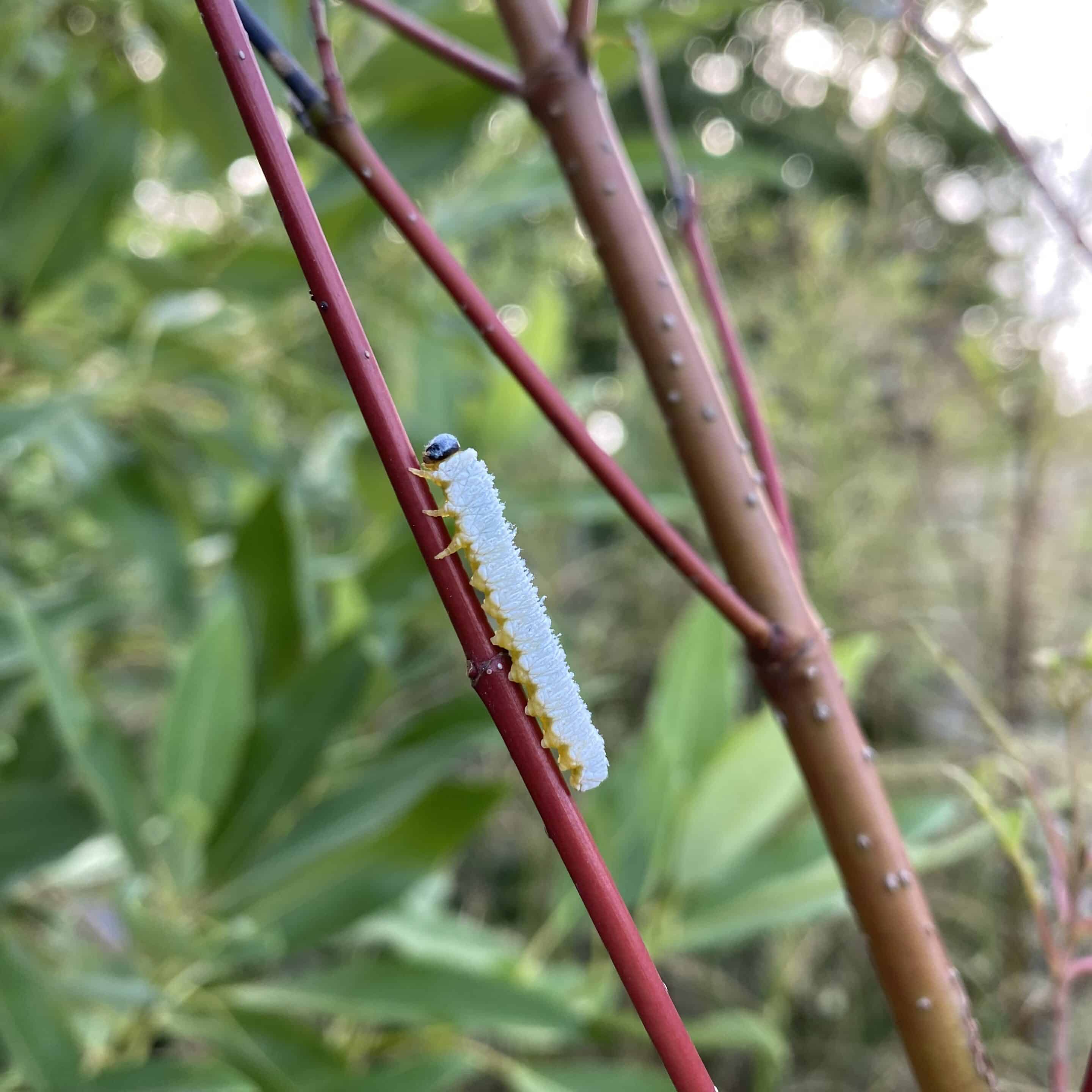
Larva of dogwood sawfly on a red-twig dogwood.
Dogwood sawflies (Macremphytus spp.) have a bad reputation as a garden pest. The larvae feed voraciously on the leaves of many dogwood species. Affected leaves appear skeletonized, and, in some cases, whole plants are nearly defoliated. Understandably, gardeners are often distressed by the sight of their plants being eaten bare. But is this distress warranted? How bad are dogwood sawflies really for your plants? Will they kill your dogwoods, or is the damage just aesthetic?
The short answer is that defoliation caused by dogwood sawflies is almost always aesthetic and nothing more. Mature, well-established dogwoods will bounce back with no problem, often even regrowing new leaves in the same season. Let’s take a closer look at the dogwood sawfly to better understand their relationship with dogwoods, and the role they play within our gardens.
Description
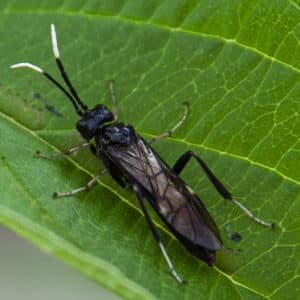
An adult dogwood sawfly.
Dogwood sawflies are in the family Hymenoptera, meaning they’re related to ants, bees, and wasps. Indeed, sawflies do look like wasps. Adults are small, no more than half an inch, with glossy-black bodies and dark translucent wings. However, despite their waspish appearance, sawflies lack stingers and are harmless to humans. Their name comes from the saw-like ovipositor, or egg-laying organ, that females use to deposit eggs within dogwood leaves.
Dogwoods (Cornus sp.) are the sawflies host plant. This means sawflies use the leaves of dogwoods, and only dogwoods, to lay their eggs in. In addition, the leaves of dogwoods are the vital food source for sawfly larvae. Being born a sawfly on a dogwood is like being born in an all you can eat buffet. And they sure are hungry.
Young sawflies have three larval stages, and begin eating as soon as they hatch. They are gregarious, meaning they stick together in groups. Up to a dozen can be found on a single leaf, and hundreds on a single plant. Hatchlings are tiny, pale green to orange, and nearly translucent. Their tiny mandibles can only strip away outer layers of leaf tissue. As sawflies grow, they molt; and in their second larval stage they are covered in a powdery white coating. Now they are large enough to begin skeletonizing leaves, chewing up all the leaf tissue between leaf veins. Finally, in their third larval stage, sawflies stretch to an inch, sometimes two, and are yellow with black blotches on their backs. Now their mandibles are tough enough to devour the remaining leaf veins, aside from the midrib.
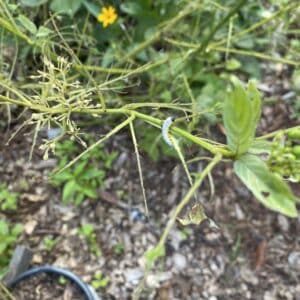
A skeletonized branch of Cornus sericea.
Dogwood Species Preference
As noted, all dogwoods are host plants to the dogwood sawfly. However, sawflies seem to prefer shrubby dogwood species as opposed to larger species. Dogwood sawflies are especially fond of red-twig dogwoods (Cornus sericea) and gray dogwoods (Cornus racemosa). They are less commonly found on tree-type species such as the Flowering Dogwood (Cornus florida). Researchers are not entirely sure why this is, though it’s suspected that some chemical compound in the leaves of C. florida make it unpalatable to eat, or unviable as a nesting site. If a compound is the cause for sawfly resistance, it’s possible this trait can be bred into other dogwood species and varieties, making them more resistant to sawflies as well.
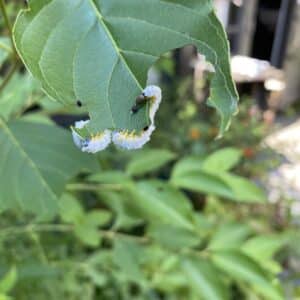
Dogwood sawfly larvae eating a leaf.
Do Dogwood Sawflies Kill Dogwood Plants?
No. Or at least not often. As already mentioned, the damage caused by sawfly larvae is mostly aesthetic. Healthy trees or shrubs will have no problem bouncing back. For example, here at Lauren’s Nursery, most of our planted dogwoods have been largely defoliated by sawfly larvae. Despite this, some of our dogwoods are already sprouting new leaves. This happens every year, and always the plants come back, seemingly unphased. Why is this?
Dogwoods and dogwood sawflies evolved together over hundreds of thousands of years. Dogwoods have adapted to predation by sawflies and can tolerate their feasting. In a way, it’s similar to how grasses tolerate grazing by cattle, bison, deer, etc. Furthermore, if sawfly larvae killed their host plants, they’d have nowhere to lay their eggs next year and would die out. Sawflies count on the dogwoods resilience for the continuation of their own species.
With all that said, occasional plant fatalities may occur due to sawfly defoliation. This often happens to already weakened plants, stressed by concurrent diseases or improper growing conditions. Occasionally young plants with weak or underdeveloped root systems may succumb as well. Almost always, however, the dogwoods will survive.
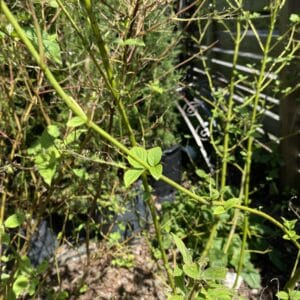
New growth emerging after defoliation on a Cornus sericea.
Prevention and Management
There are a few ways to prevent and manage dogwood sawfly larvae from taking over your dogwood plants. First, you can trim and remove leaves that contain sawfly eggs. You’ll know if a leaf has eggs in it if it has lines of brown dots running parallel to the leaf’s veins. The dots are the leaf’s scar tissue, a by product of the sawfly’s oviposition. You may also consider planting dogwood species that aren’t favorites of the sawfly. For example, Cornus florida as opposed to Cornus sericea.
Sawfly larvae, like many caterpillars and larval-stage insects, are an important food source for birds, parasitic wasps, and other predatory insects. You can encourage predation from insects and birds by keeping a safe, pesticide-free garden which will attract natural predators. Consider adding birdhouses and extra habitat to your garden. You may even consider not setting out birdfeed while sawfly larvae are present, which will further encourage birds to leave the feeder and eat the larvae.
Finally, consider taking a lesson from the dogwoods, and, like them, learn to tolerate the sawflies presence. Killing the larvae may help your dogwood stay prim and proper, but to the detriment of our local ecosystems. As noted, dogwood sawflies are an important food source to many insects and birds and, in turn, are a key part of the greater food web.
Sawflies also add new dynamics and natural excitement to the garden. Hold your ear close to a leaf with larvae on it and you can hear them chewing. Watch as a wasp abducts a larva, carrying it off to some grim fate. Or delight in the catbirds and titmice plucking the sawflies from the leaves with glee.
The plants in your garden need not always look perfect. By leaving the sawflies alone, your garden is acting as a functional part of the ecosystem, rather than a closed, aesthetic place.
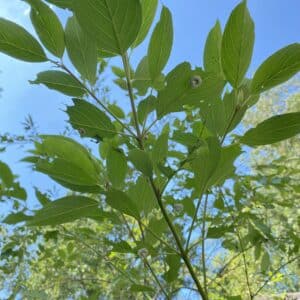
Dogwood sawfly larvae resting on the underside of a leaf.
******
Sources:
University of Massachusetts Amherst
Iowa State University Extension
Horticultural Research Institute