
Maryland Native Plants: Actaea pachypoda – Doll’s Eyes Baneberry

Maryland Native Plants
Actaea pachypoda – Doll’s Eyes Baneberry
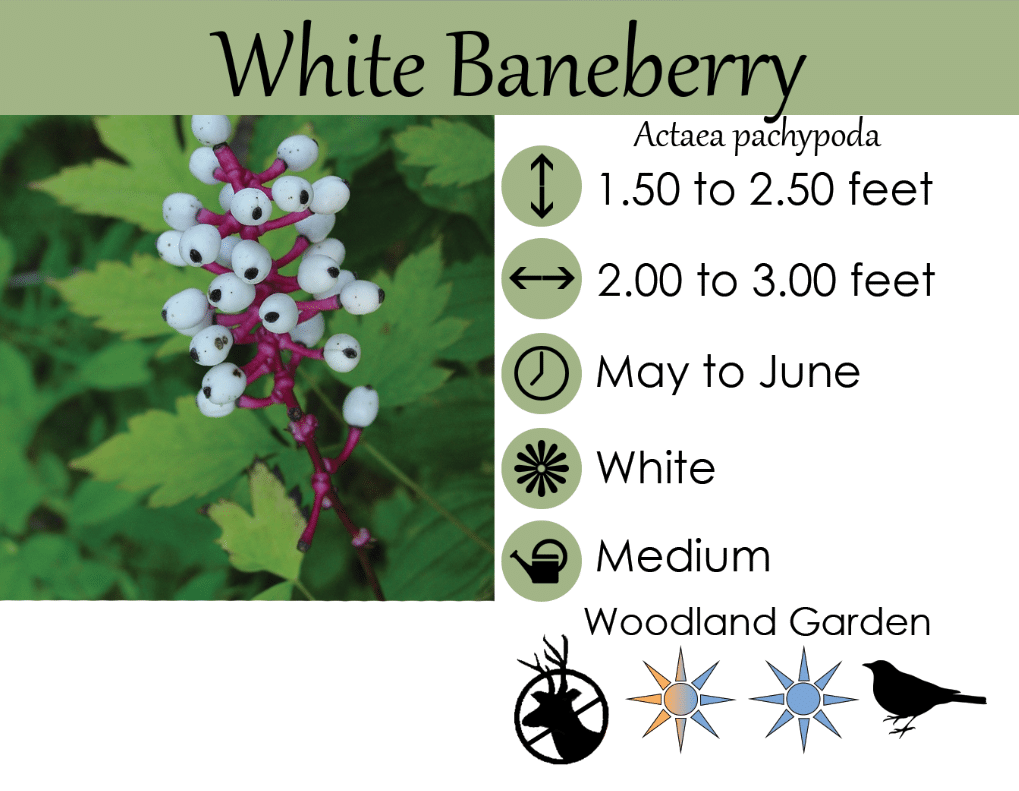
Growing Information
Baneberry prefers rich, moist woodland soils, but is fairly adaptable. Soils should not be allowed to dry out, but need good drainage to prevent boggy conditions from developing. It does best in part shade to full shade. Self-seeding may occur in optimum growing conditions where the berries fall to the ground. If naturalization is desired, berries may be picked and immediately planted into the ground as soon as they ripen in order to promote colonial spread.
Habit
Doll’s Eyes Baneberry spreads by self-seeding, naturalization, and rhizome formation, resulting in thicket formation. However, it is not considered aggressive, and will typically not out-compete other species. Baneberry typically reaches heights of 1-3 feet and widths of 2-3 feet, with small white flowers emerging in the late spring.
Fast Facts
All parts of this plant are toxic to humans and domestic animals and should be planted cautiously in areas where children or pets may be able to access it. Birds and small wild mammals are not affected by the poisonous nature of the berries, and some species of bird will feed on the berries throughout the fall and winter. These species include the Ruffed Grouse, Yellow-Bellied Sapsucker, and American Robin (Eastman, 1992, pp. 12-13). The White-Footed Mouse will also eat the berries, but the foliage contains a cardiac glycoside that is toxic to mammalian herbivores making this plant a very good option for high-deer pressure locations!
The flowers of the Doll’s Eyes Baneberry do not produce nectar, only pollen, and are primarily visited by short-tongued bees in the Halictid, or sweat bee, family.
Baneberry technically resides in the buttercup family (Ranunculaceae).
Plant Information
Common Name: White Baneberry or Doll’s Eyes
Type: Herbaceous perennial
Family: Ranunculaceae
Height: 1.50 to 2.50 feet
Spread: 2.00 to 3.00 feet
Root: Fibrous and rhizomatous
Bloom Time: May to June
Bloom Description: White
Sun: Part shade to full shade
Water: Medium (Keep Moist)
Maintenance: Low
Suggested Use: Naturalize
Flower: Showy, Fragrant
Fruit: Showy
(Information from Missouri Botanical Garden, Illinois Wildflowers, and NC State Extension)
*
*